Dell PowerEdge with AMD EPYC
Scale AI with confidence and reduce risk with Dell and AMD
Performance density, without the licensing penalty
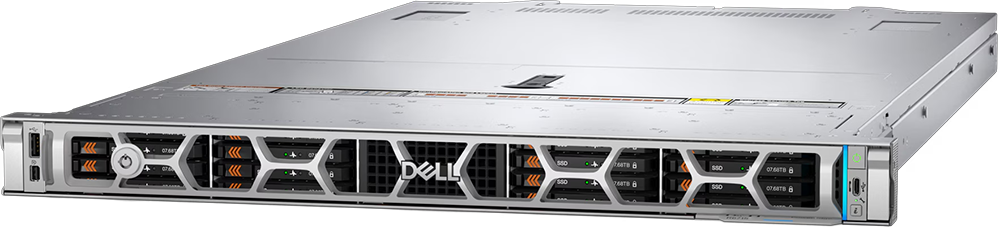
Dell PowerEdge servers built on AMD EPYC processors concentrate high core counts, dense DDR5 memory and PCIe Gen5 connectivity into a single socket — so you can consolidate ageing infrastructure, right-size per-core licensing and free up rack space, power and cooling for the workloads that actually grow your business.
Why AMD EPYC on PowerEdge
Moving to AI and modern data-intensive workloads is a risk-management exercise as much as a performance one. Pairing AMD EPYC silicon with the PowerEdge platform gives you a validated, single-vendor path from proof of concept to production — with one support contract, one systems management toolset and one security architecture across the whole estate.
Core density
Up to 192 cores per processor on 5th Generation AMD EPYC 9005 Series parts. Consolidate racks of older two-socket servers into a far smaller footprint and reclaim the power and cooling budget.
Licensing control
Per-core licensing drives much of the true cost of a virtualized estate. High-performance single-socket designs let you match core counts to your hypervisor and database licensing instead of paying for cores you will never use.
Confidential computing
AMD Secure Encrypted Virtualization (SEV) and Secure Memory Encryption (SME) extend protection to memory itself — important for multi-tenant, virtualized and regulated environments.
Efficiency
Titanium-rated power supplies and DC-MHS open standards compliance across the current generation help keep energy draw in check, with both air-cooled and liquid-cooled options so the platform can match your facilities.
Projected CAGR for the worldwide server market through 2029 as businesses modernize1
Lower software licensing cost when replacing a five-year-old server2
Higher performance per core than the previous generation3
Cores per processor on 5th Gen AMD EPYC 9005 Series
Cores in a single socket on the R6715 and R7715
NVIDIA HGX B200 GPUs per AMD-based XE9685L node
AMD Servers for Small and Mid-Size Businesses
The PowerEdge R4715 and R5715 with the 5th Gen AMD EPYC™ processor bring single-socket economics to growing businesses: up to 32 cores and 1.5TB of DDR5 in a platform sized for virtualization, databases and the edge — without paying for a second socket you will not use.
Scale AI with confidence
AI workloads stall when the host platform starves the accelerators. AMD EPYC brings the core count, memory bandwidth and PCIe Gen5 lanes needed to keep GPUs fed — and Dell wraps that in a factory-integrated, fully supported system rather than a parts list.
PowerEdge XE9685L
Dual-socket AMD EPYC 9005 Series processors with up to 8 NVIDIA HGX B200 GPUs in a 4U liquid-cooled chassis — built for large-scale AI training.
- High GPU density per rack for training and fine-tuning
- Liquid cooling for sustained performance under load
PowerEdge XE7745
Two 5th Generation AMD EPYC 9005 Series processors with up to 192 cores each, purpose-built for evolving AI-powered enterprise performance and scalability needs.
- Air-cooled AI platform for enterprise data centers
- Strong fit for inference, RAG and fine-tuning workloads
Browse the full AI server portfolio | Dell AI Factory with NVIDIA | Storage for AI
The AMD EPYC PowerEdge portfolio
Current generation — 5th Gen AMD EPYC 9005 Series
Single-socket platforms sized for the midmarket and for licensing-sensitive virtualized estates:
Dual-socket platforms for maximum performance density:
Previous generation — 4th Gen AMD EPYC 9004 Series
Proven 16th generation platforms, still widely deployed and available for estate standardization:
Choosing between one socket and two
The single-socket AMD EPYC platforms are frequently the better economic answer, not the compromise they used to be. Use this as a starting point, then talk to a specialist about your actual licensing and workload profile.
| If your priority is… | Consider | Why |
|---|---|---|
| Cutting per-core licensing | R4715, R5715, R6715, R7715 | One socket lets you match core count to hypervisor and database licensing rather than paying for cores you will not use. |
| Maximum VM density | R6725, R7725 | Two 5th Generation EPYC 9005 processors at up to 192 cores each provide the largest core count available in the PowerEdge rack line, for the deepest consolidation ratios. |
| Storage-heavy workloads | R5715, R7715 | 2U chassis provide the drive bay count for backup targets, file serving and video surveillance retention. |
| Scale-out and HPC | C6615 | Dense multi-node design drives down cost per node for workloads that scale horizontally. |
| AI training and inference | XE9685L, XE7745 | EPYC core count and PCIe Gen5 bandwidth keep GPUs fed; choose liquid-cooled XE9685L for density, air-cooled XE7745 for standard facilities. |
Reduce risk across the lifecycle
Security built into the silicon
PowerEdge Cyber Resilient Architecture anchors boot integrity in a silicon root of trust, with cryptographically signed firmware, Secured Component Verification, Secure Boot, system lockdown and chassis intrusion detection. AMD SEV and SME add memory encryption on top. Protection starts in a secured supply chain and continues through factory-to-site integrity assurance.
One management plane
iDRAC, OpenManage Enterprise and CloudIQ manage AMD and Intel PowerEdge systems through the same tools, so a mixed estate does not mean a second set of processes. Automation and lifecycle management scale with the environment instead of against it.
Services at every phase
ProDeploy accelerates time to value, ProSupport provides proactive and predictive support, and Professional Services for AI helps move use cases into production. Consulting services are available for planning and migration work.
Complete the solution with Dell storage
Compute is only half the answer. AI and consolidation projects succeed or fail on the data layer — how fast it feeds the GPUs, how well it scales, and how reliably it can be recovered.
- IDC, Servers Market Insights, October 2025.
- Based on Dell analysis of SPEC FP Rate scores of the 24-core AMD EPYC CPU in the PowerEdge R5715 (464) versus an HPE ProLiant DL360 Gen10 Plus with 2x 32-core Intel Xeon Platinum 8358 CPUs (438). Both score similarly, but the Dell server achieves it with 62.5% fewer cores — with core-licensed software like Windows Server 2025 that equates to a 62.5% reduction in licensing costs. Data accurate as of 1/29/2026.
- Dell PowerEdge R5715 with AMD EPYC 9135 achieves a score of 350 in SPEC CPU 2017 FP Rate, versus 229 for a PowerEdge R7615 with AMD EPYC 9124 — a 52.83% improvement. Actual performance may vary.
Source: Dell Technologies, “Modernize Your Infrastructure, Maximize Your Value” infographic, March 2026.
Questions? We’re here to help.
From offering expert advice to solving complex problems, we’ve got you covered. Get in touch with a Dell Solutions Specialist today to learn more!
An authorized Dell Storage reseller, and a Dell Technologies Titanium Partner
The widest range of in-stock products, fast shipping, and the advice of certified product experts
Our team can bring you together with the presale engineering team
A flagship brand of BlueAlly, a national leader in IT solutions since 2013
Contact Us
Talk to a specialist right now: 800-886-5369