AMD Servers for Small and Mid-Size Businesses
Dell PowerEdge R4715 and R5715 servers with the 5th Gen AMD EPYC™ processor deliver modern capabilities while reducing complexity and costs
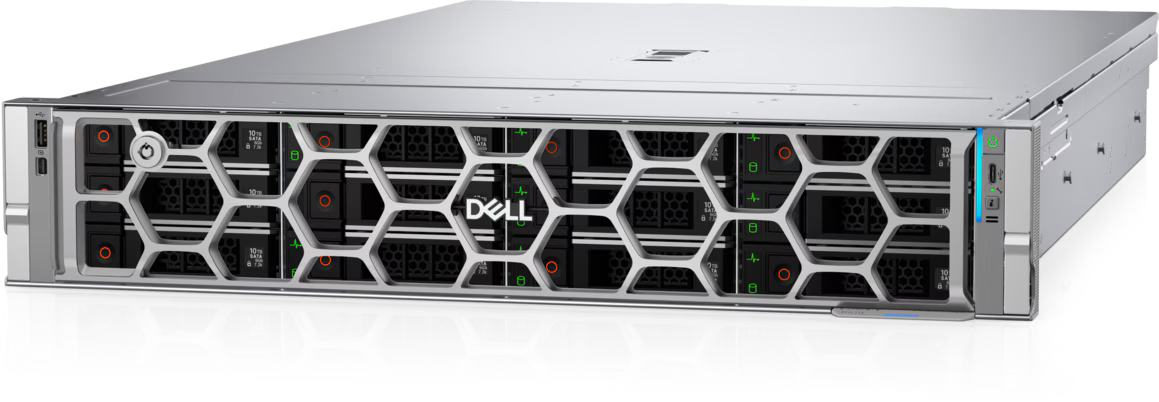
Two servers, one decision
Same processor, same memory ceiling. The choice comes down to rack space against expansion room.
| Model | Form factor | PCIe Gen5 slots | Best for |
|---|---|---|---|
| PowerEdge R4715 | 1U | Up to three | A smaller rack footprint |
| PowerEdge R5715 | 2U | Up to four | Greater expansion capacity |
The one-socket advantage: enterprise power, smarter economics
A common misconception in the server market is that more is better. For years, dual-socket servers were the standard for performance, and they remain an excellent choice for many demanding applications. However, advances in processor density mean that a modern single-socket server can provide powerful, efficient compute while reducing platform complexity, making it a great option for those transitioning from older hardware or desktop systems.
By utilizing a single, high-core-count processor, these servers eliminate the need for a second CPU, which reduces upfront hardware costs versus dual-socket architectures. The savings can extend beyond hardware, but by two different routes worth keeping apart. Where software is licensed per socket, one socket in place of two halves that line directly. Where it is licensed per core — Windows Server and most database engines — the saving comes from needing fewer cores to do the same work, and the socket count is beside the point. Which applies, and what it adds up to, depends on your configuration and your agreements. A single-socket environment also simplifies workload management, without the complexity that comes with multi-processor memory access.
The TCO equation
- Lower acquisition cost:
- Buy only the compute power you need.
- Reduced OpEx:
- Lower power consumption and cooling requirements.
- Licensing savings:
- Fewer sockets, and fewer cores for the same work. How much that saves depends on your licensing terms.
A single-socket architecture allows growing businesses to invest in storage or memory capacity rather than unnecessary sockets.
Increased performance per core versus previous generation server2
Fewer licensed cores for the same SPEC FP Rate score, against a 5-year-old two-socket server3
Cores in a single 5th Gen AMD EPYC™ processor for dense workload consolidation
DDR5 memory for demanding workloads
Read the 62.5% as a core count, not a socket count. Dell’s comparison puts 24 licensed cores on one R5715 where an older two-socket server needed 64 for a comparable SPEC FP Rate score, priced under core-based licensing such as Windows Server 2025.3 Socket-based licenses work differently. What any of it is worth on your invoice depends on your configuration, your workload and the terms you have signed — worth checking with us before you budget against it.
Meet the Dell PowerEdge R4715 and R5715
Dell PowerEdge R4715 and PowerEdge R5715 servers are purpose-built to bring mainstream performance to value-conscious businesses. They feature the latest AMD EPYC™ architecture, designed to handle demanding workloads with efficiency.
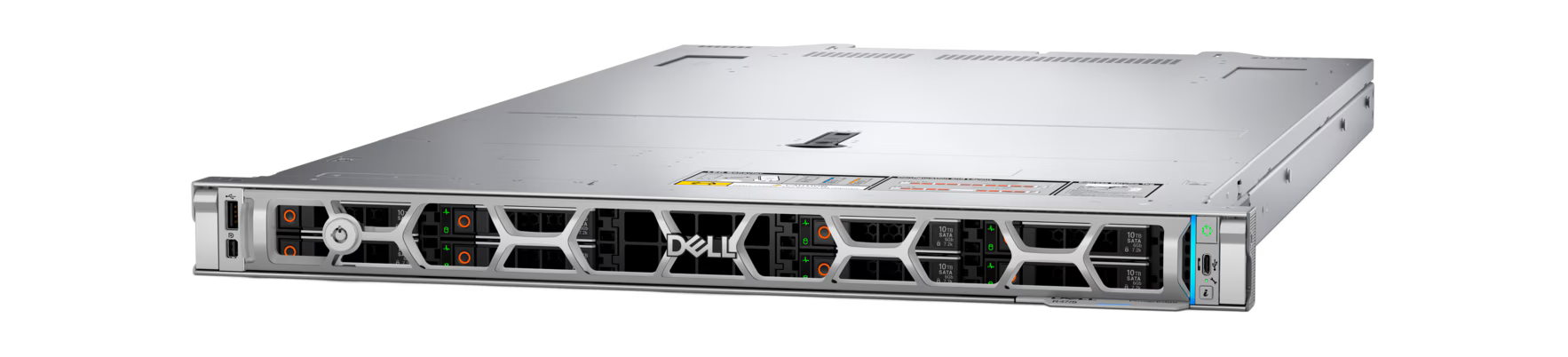
Dell PowerEdge R4715
An ideal replacement for aging tower servers or inefficient legacy rack units. Perfect for businesses moving from tower-based architecture to rack-mounted efficiency.
- Up to three PCIe Gen5 slots for high-speed networking or storage controllers
- Stack more compute in a smaller 1U footprint
- Up to 246TB with NVMe™ as an option to give you faster access to data
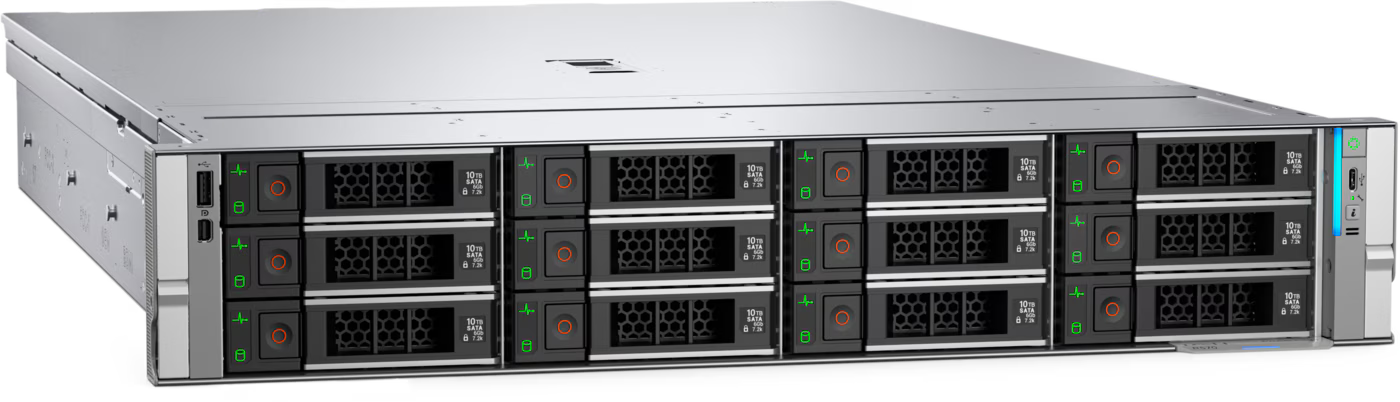
Dell PowerEdge R5715
For organizations requiring more I/O bandwidth and expandability, the PowerEdge R5715 server steps up the capability while maintaining single-socket efficiency.
- Up to four PCIe Gen5 slots for high-speed networking or storage controllers
- Lightning-fast data transfer and expanded connectivity
- Support for up to 288TB storage
What both servers give you
| Core density | Supports up to one 32-core 5th Gen AMD EPYC™ processor for dense workload consolidation |
|---|---|
| Speed | AMD “Zen 5” core architecture, provides up to 17% better instructions per clock (IPC) for enterprise and cloud workloads4 |
| Memory | Up to 1.5TB of DDR5 memory keeps applications running smoothly |
| Scalability | Add networking or storage without the need to upgrade |
| Design | Air-cooled architecture helps keep energy costs low |
| Serviceability | A refined chassis with toolless access to key components and streamlined internal cable management, reducing the hands-on time required for hardware swaps or upgrades |
They are ideal for
- Virtualization and private cloud
- Data analytics and databases
- Software-defined storage
- Edge and space-constrained environments
- High-performance compute at optimized cost
Workloads that drive your business forward
Up to 32 cores and 1.5TB of DDR5 in one socket is enough to fold several ageing servers into a single box. Three workloads make that case best.
Virtualization and VDI
32 cores and 1.5TB of memory carry a lot of virtual machines at once, so consolidation does not cost you headroom under load.
Databases and analytics
DDR5 memory and PCIe Gen5 connectivity keep data moving fast enough for:
- In-memory databases: faster access to critical business data
- Real-time analytics: shortening the gap between data arriving and insight
- Business intelligence: running complex queries rapidly to support decision making
Edge computing
Retail chains, manufacturing plants and remote branch offices rarely have a proper machine room. A 1U or 2U air-cooled chassis fits the space and power they do have, and puts real compute where the data is made.
- Real-time decision making: process data locally to trigger immediate actions, such as adjusting assembly line speeds or updating retail inventory, without waiting on a round trip to the cloud
- Reduced bandwidth costs: filter and analyze at the source instead of shipping whole datasets back to a central core
- Enhanced reliability: local operations keep running when the link to the central data center drops
Energy efficiency: more power, less cooling
Air-cooled, with high-efficiency power supplies and thermal sensors that keep the fans off the throttle. You get more compute per watt than the generation before — up to 52% more performance per core2 — inside the same power envelope.
For many sites that means more workloads inside the power and cooling already in place, though how far it stretches depends on what you run and what the rack can take.
What that is worth
- Operational savings: replacing aging infrastructure with modern servers cuts energy usage, which lands straight on the bottom line
- Sustainability: lower consumption means a smaller carbon footprint against green infrastructure targets
A server family built to scale with you
The R4715 and R5715 share their architecture with the rest of the PowerEdge line, so there is one management interface, one deployment workflow and one security protocol to learn — whether you run a single server in a branch office or a cluster of R7715s in a data center.
That commonality is what makes firmware updates and troubleshooting quick, and it spares you the hidden tax of training staff on a second platform.
As your data grows and your workloads get more complex, the same management platform extends to high-density models designed to handle demanding enterprise workloads like AI inferencing and high-performance computing (HPC).
Common questions
The four that come up in almost every conversation about these two servers.
Both run the same 5th Gen AMD EPYC™ processor with the same 32-core and 1.5TB memory ceilings, so the decision is about chassis, not compute. Take the 1U R4715 when rack space is the constraint and up to three PCIe Gen5 slots covers your networking and storage cards. Take the 2U R5715 when you need a fourth PCIe Gen5 slot or the extra drive capacity, up to 288TB against 246TB.
It depends on how your software is licensed. Per-socket licensing halves on socket count when you go from two sockets to one. Per-core licensing, which covers Windows Server and most database engines, saves only when you need fewer cores for the same work — Dell’s comparison shows 24 licensed cores doing the job of 64 at a comparable SPEC FP Rate score. The socket count is beside the point in that case. Your own figure depends on your configuration, your workload and the terms you have signed, so treat the published numbers as an illustration rather than a quote.
Start from what you run today rather than the server you are replacing. A single 32-core processor with 1.5TB of DDR5 covers most virtualization, database, analytics and file workloads at small and mid-size scale, and consolidates several older servers into one. The cases that still want two sockets are the ones bound by raw core count or memory bandwidth — large in-memory databases, dense VDI at scale, HPC. If you are unsure which side of that line you fall on, the sizing is worth a conversation before you buy.
Yes. Our Dell Solutions Specialists and presale engineers will size the processor, memory, drives and PCIe cards against your actual workload, check it against your licensing position, and quote the result. Use the form at the foot of this page or call 800-886-5369.
Resources
The Power of a Right-Sized Server
Dell PowerEdge R4715 and R5715 servers with the 5th Gen AMD EPYC™ processor deliver modern capabilities while reducing complexity and costs.
Read the ebook- IDC, Servers Market Insights, October 2025.
- Dell PowerEdge R5715 with AMD EPYC 9135 CPU achieves a score of 350 in SPEC CPU 2017 FP Rate. Dell PowerEdge R7615 with AMD EPYC 9124 scores 229 in SPEC CPU 2017 FP Rate. This represents a 52.83% performance improvement. Actual performance may vary.
- Based on Dell analysis of SPEC FP Rate scores of the 24 core AMD EPYC CPU in the PowerEdge R5715 (464) with the SPEC FP rate of an HPE ProLiant DL360 Gen10 plus with 2x 32 core Intel Xeon® Platinum 8358 CPUs (438). Both have similar SPEC-FP scores but the newer Dell server is able to achieve the same with 62.5% fewer cores. With core licensed software like Windows Server 2025, this would equate to a 62.5% reduction in licensing costs. Data accurate as of 1/29/2026. Actual performance may vary.
- Based on AMD internal testing as of 9/10/2024, geomean performance improvement (IPC) at fixed-frequency.
Questions? We’re here to help.
From offering expert advice to solving complex problems, we’ve got you covered. Get in touch with a Dell Solutions Specialist today to learn more!
An authorized Dell Storage reseller, and a Dell Technologies Titanium Partner
The widest range of in-stock products, fast shipping, and the advice of certified product experts
Our team can bring you together with the presale engineering team
A flagship brand of BlueAlly, a national leader in IT solutions since 2013
Contact Us
Talk to a specialist right now: 800-886-5369